
Our Crowdfunder campaign is now LIVE. We're raising £40,000 to help communities discover, monitor and care for the changing marine wildlife on their local coastline. Click here to find out more.
April 29, 2026
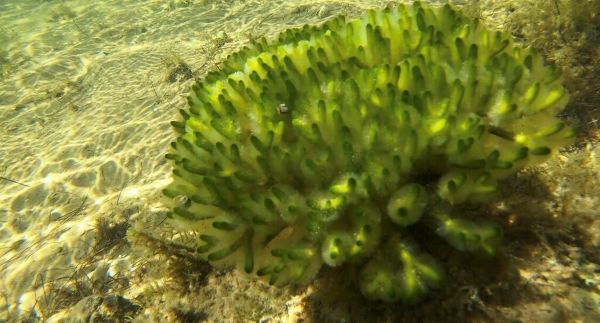
Codium fragile, subsp. fragile (C. f. fragile), commonly known as Dead Man’s Fingers or Green Sea Fingers, was first described by Suringar in 1867. While native to East Asia, it has become a widespread invasive algae found across the coastlines of the UK, Ireland, and Europe. On iNaturalist, there are currently over 11,000 research-grade observations for Codium fragile, and over 80 observations for Codium fragile ssp. fragile.
Dead Man's Fingers is easily identified by its green colour and distinct "spongy" texture. The organism has a finger-like structure with dichotomous branching, where the stalks consistently fork into two. These branches typically measure between 3–10mm in width, while the entire algae can reach lengths of 15–40cm.
.png)
While Dead Man's Fingers is typically green, its appearance shifts significantly throughout its life cycle. In their juvenile stage, they appear as low, moss-like mats rather than distinct fingers. As they mature and begin to branch, active new growth is often indicated by bright yellow tips.
Environmental factors also play a role in their coloration; during low tide, individuals exposed to the air may take on a significantly darker green hue as they begin to dry out. Perhaps most fascinating is their reaction to light; if you engage in night- time rock pooling with a UV torch, the algae exhibits striking biofluorescence, transforming into a beautiful, vibrant red.
.png)
.png)
Dead Man’s Fingers belongs to the genus Codium, which comprises over 140 species worldwide. Many of these species are almost identical to the naked eye, making field identification difficult. Specifically, the non-native C. fragile, subsp. fragile is virtually indistinguishable from the UK natives Codium tomentosum and Codium vermilara without the use of a microscope.
The graphic below illustrates the diagnostic differences in their branch tips (mucrons) that allow for definitive identification.
.png)
Codium fragile has a subspecies called fragile (Codium fragile subsp. fragile), which contains a total of 5 species. Many of these do not have records in the UK. Therefore C. fragile sub-species fragile is not easily confused with others in the subset when finding this algae in the UK.
The algae is commonly preyed on by tiny marine invertebrates, snails and fish. Alongside marine animals, this algae is know to be a healthy for humans, and can be added to salads raw, and is not generally cooked. One species in particular, the Solar-powered Sea Slug (Elysia viridis) has a diet consisting of various algae, but primary eats Codium, including C. f. fragile
This species is highly adaptable, occupying both intertidal and shallow subtidal zones. It is frequently found attached to rocks in pools and can tolerate a wide range of temperature, salinity and nutrient levels.
The algae is non-native, and known to be invasive. It originated from Asia, and has spread through Europe, Mediterranean, North America, Australia and New Zealand. Codium fragile spreads primarily through human activities, such as the accidental transport of fragments on boat hulls and equipment. While natural dispersal methods, including wind-driven movement and buoyant transport via ocean currents, may have occurred.
Codium fragile subsp. fragile: iNaturalist - most up to date records of the subspecies' current occurrence.
Codium fragile (species level): iNaturalist - most up to date records of the species' current occurrence.
Bridgwood, S. (2010). Codium fragile ssp. fragile (Suringar) Hariot summary document. Fisheries Research Report No. 202. Department of Fisheries, Western Australia. 12 p.
Bulleri, F., Benedetti-Cecchi, L., Cusson, M., Maggi, E. and Arenas, F. (2016) 'High instability in community response to species loss during early stages of succession', Ecological Modelling, 318, pp. 176–184. doi: 10.1016/j.ecolmodel.2015.08.011.
Fofonoff, P.W., Ruiz, G.M., Steves, B.P., Simkanin, C. & Carlton, J.T. (2024) Codium fragile ssp. fragile. National Exotic Marine and Estuarine Species Information System. [Online] Available from: https://invasions.si.edu/nemesis/species_summary/6897 [Accessed 6 May 2024].
GBIF Secretariat (2026) Codium fragile (Suringar) Har. [Online] Available from: https://www.gbif.org/species/5272096 [Accessed 6 May 2026].
John Bishop & Christine Wood (2020) Identification Guide for Selected Marine Non-Native Species. GB Non-native Species Secretariat (NNSS). [Online] Available from: https://www.nonnativespecies.org/assets/MBA-NNS-Guide-2020-1.6-MB.pdf [Accessed 6 May 2026].


