
Our Crowdfunder campaign is now LIVE. We're raising £40,000 to help communities discover, monitor and care for the changing marine wildlife on their local coastline. Click here to find out more.
April 23, 2026
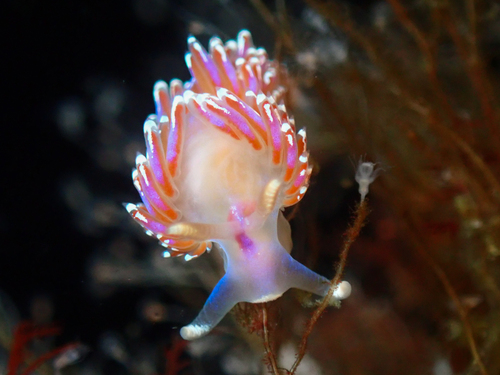
Facelina auriculata, commonly known as the crowned aeolis, or slender aeolid, was first described by O.F.Müller in 1776. They are common across a wide distribution from Norway, across Britain and Ireland and to the Meditteranean and are currently found. Currently, there are over 1,170 research-grade observations on iNaturalist and over 2,680 from the Global Biodiversity Information Facility (GBIF).
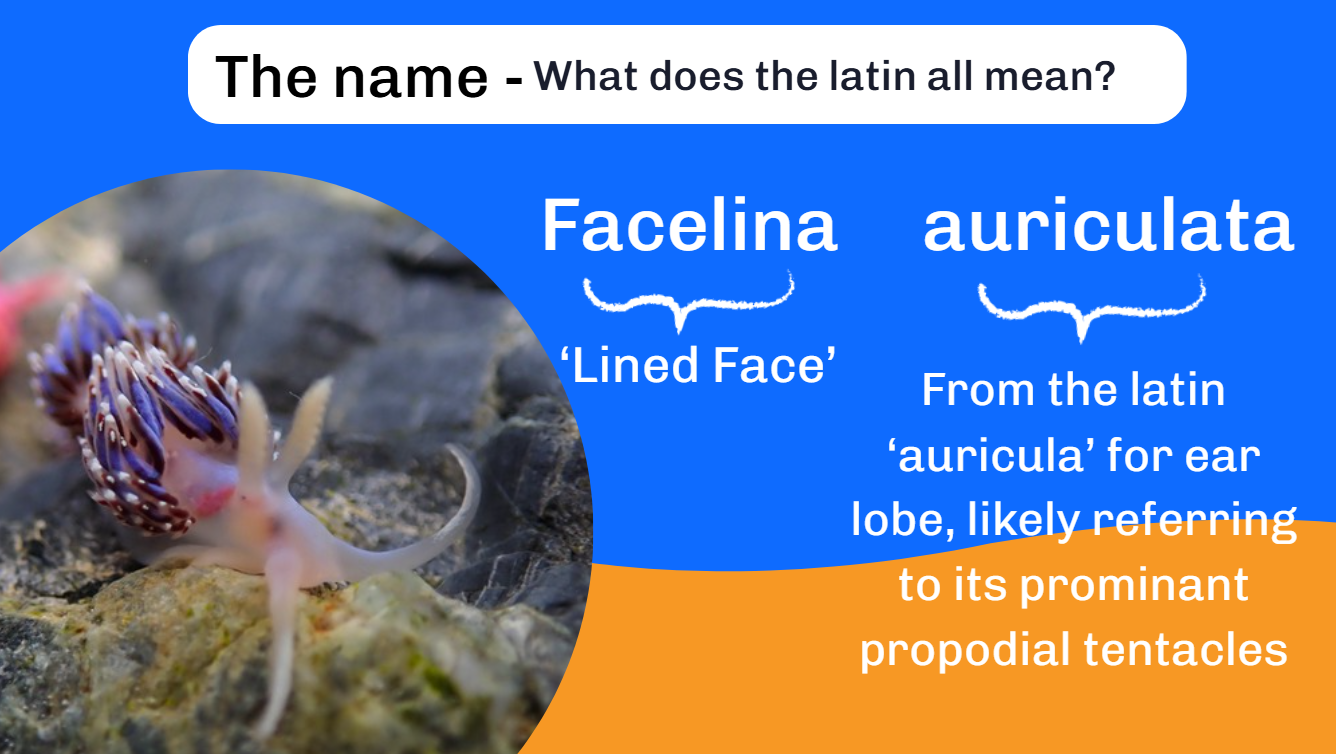
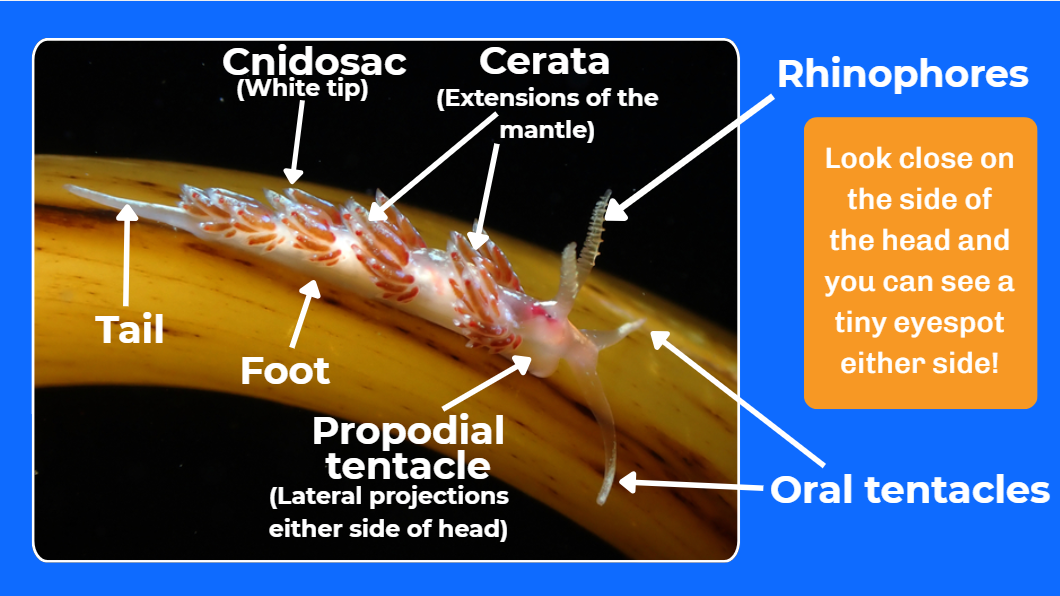
The crowned aeolis is quite small reaching a maximum length of around 38mm. They have a long body with long oral tentacles and conspicuous extensions of the mantle either side of the head called propodial tentacles. The mantle extends into long projections called cerata which are arranged in thick bands of clusters along the slug's back. These have white tips which are their 'cnidosacs', this is where the stinging cells they retain from their prey are stored for defence. Branches of their red digestive tract run up the middle of each cerata, which you can see through the thin ceratal surface.
Crowned aeolis have a characteristic iridescent blue sheen over their head and ceratal surfaces. Through their transluscent white body you can normally see a rose-coloured hue around their oesophagus and mouth. It is often possible to see glands and parts of their stomach through the top of their body as they are so translucent.
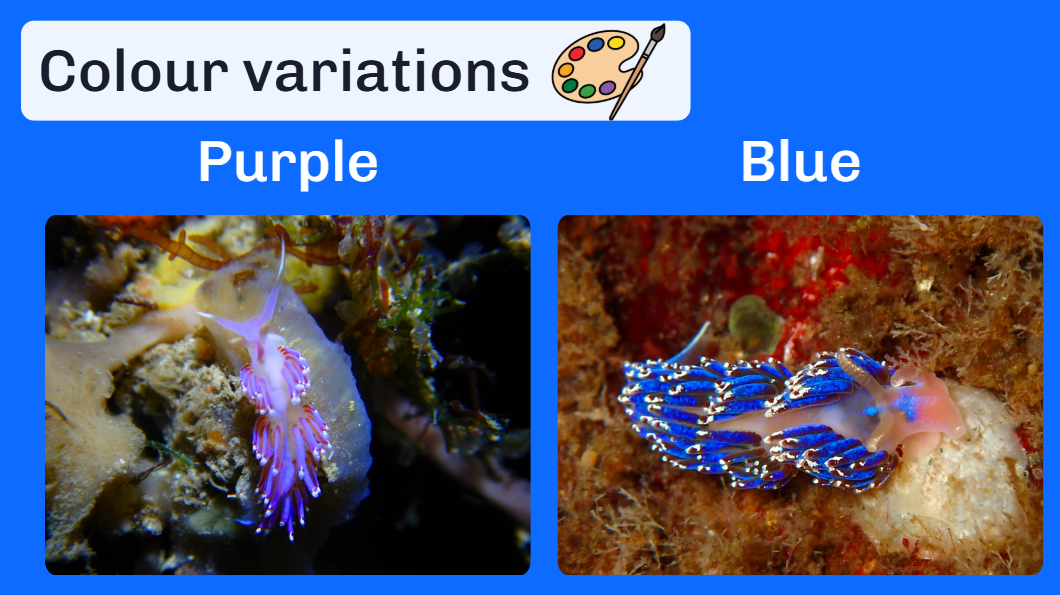
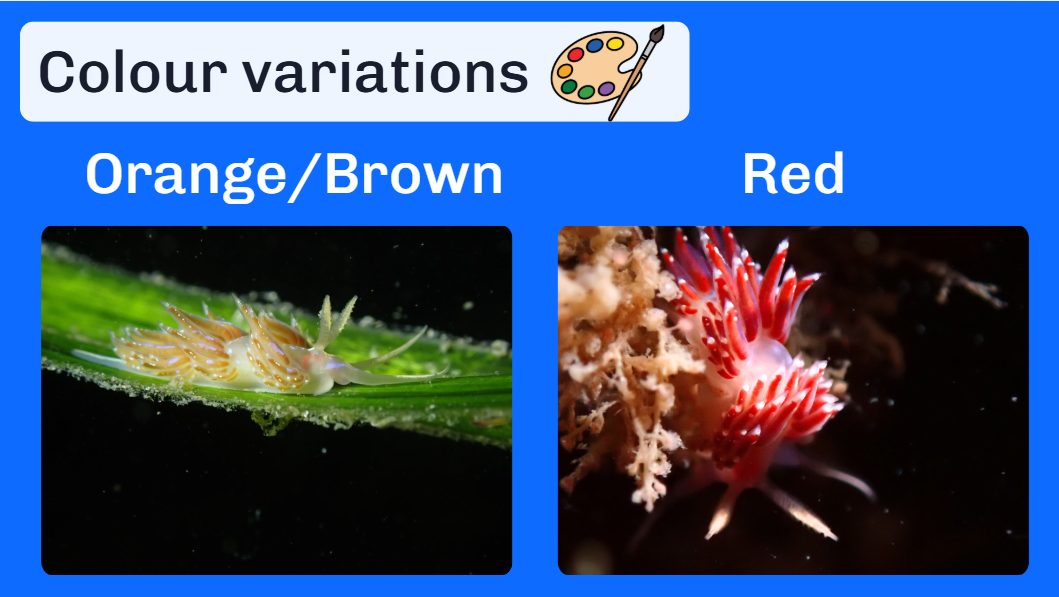
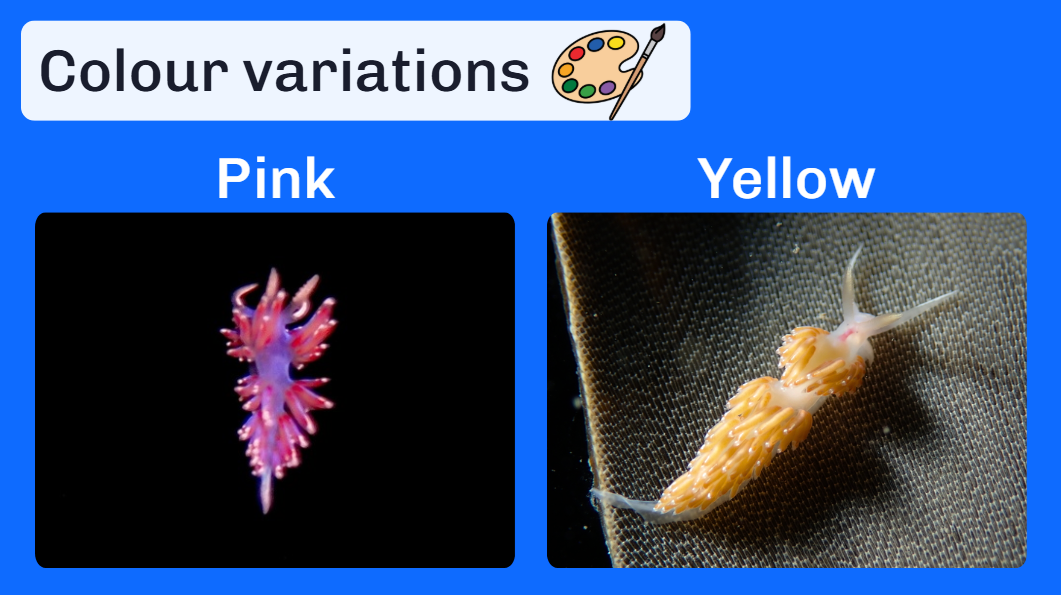
The most common colouration of this species is along the red, pink and purple spectrum, though they exhibit a lot of colour variation. Blue, yellow, orange, brown and extremely bright pink individuals can be found reasonably often. However, they should all share a rose hue around the face, red inside the cerata (from digestive tract branches) and a mainly blue but occasionally more pink or purple looking iridescence.
It is not fully known what causes changes in colouration but it appears to be a combination of health (i.e. parasitised or ill individuals may be less iridescent), and diet.
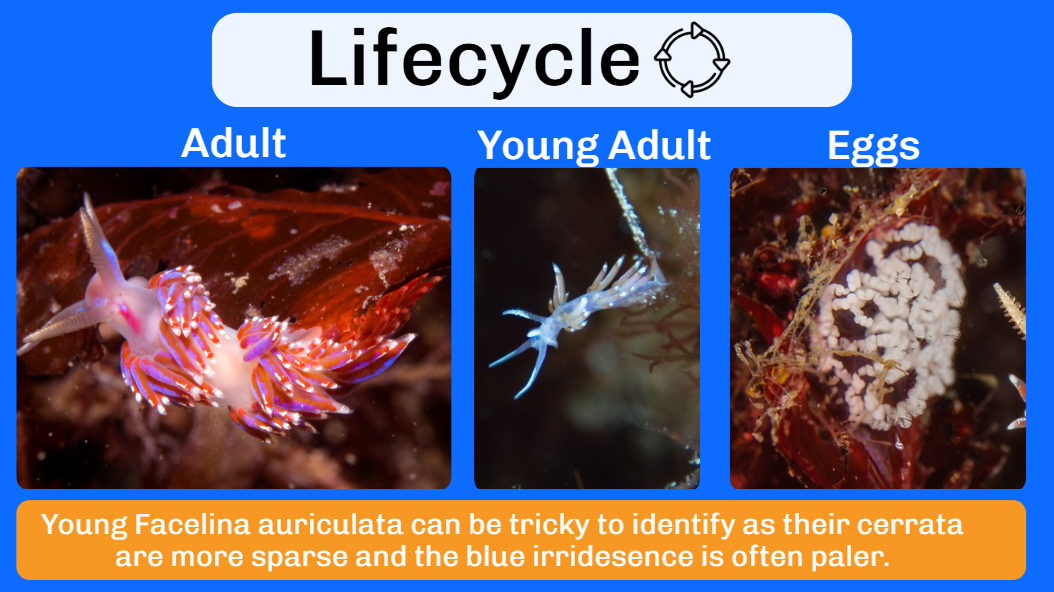
Facelina auriculata have both male and female reproductive organs, during mating they line up alongside each other and fertilise each other (this is called simultaneous hermaphrodism). Each slug will then lay bead-like chains of eggs arranged in a messy spiral. These hatch into miniature shelled larvae called veligers which drift as plankton until they settle on a suitable habitat where they metamorphose into an adult slug form and lose their shell. Reproduction typically occurs between April and October in the UK.

Large F. auriculata are unlikely to be confused with species other than F. annulicornis and F. bostoniesis in the UK. These are easily distinguishable at large sizes however as F. annulicornis is speckled and lacks blue iridesence. F. bostoniesis also lacks blue iridescence on the cerata though may have some over the body and head. Additionally, while F. auriculata's length is 8 times that of their width, F. bostoniesis' length is only 4 times that of their width and their clumps of cerata are typically more overlapping than F. auriculata's.
Smaller F. auriculata have the potential to be confused with Coryphella species however these have shorter oral tentacles, no blue iridescence and no pink blush on the face. They also have slighly spikier cerata that do not typically lie as flat as Facelina species.
The first identification feature to look out for when identifying F. auriculata is certainly the presence of blue iridescence on the cerata, and only if that is absent should other species have to be considered.
Adult F. auriculata are not known to have any predators. They separate out the stinging cells from their hydroid prey in digestion and transport them through branches of their digestive tract to the end of their cerata. There they are stored 'cnidosacs' at the tips of their cerata for use in defence if attacked. This is why if threatened many aeolid nudibranch species (ones with cerata), will straighten them, appearing almost to 'bristle' like a hedgehog.
Eggs and larvae of this species however are known to be consumed by a variety of species including fish, cushion stars and other smaller nudibranchs like Favorinus branchius.
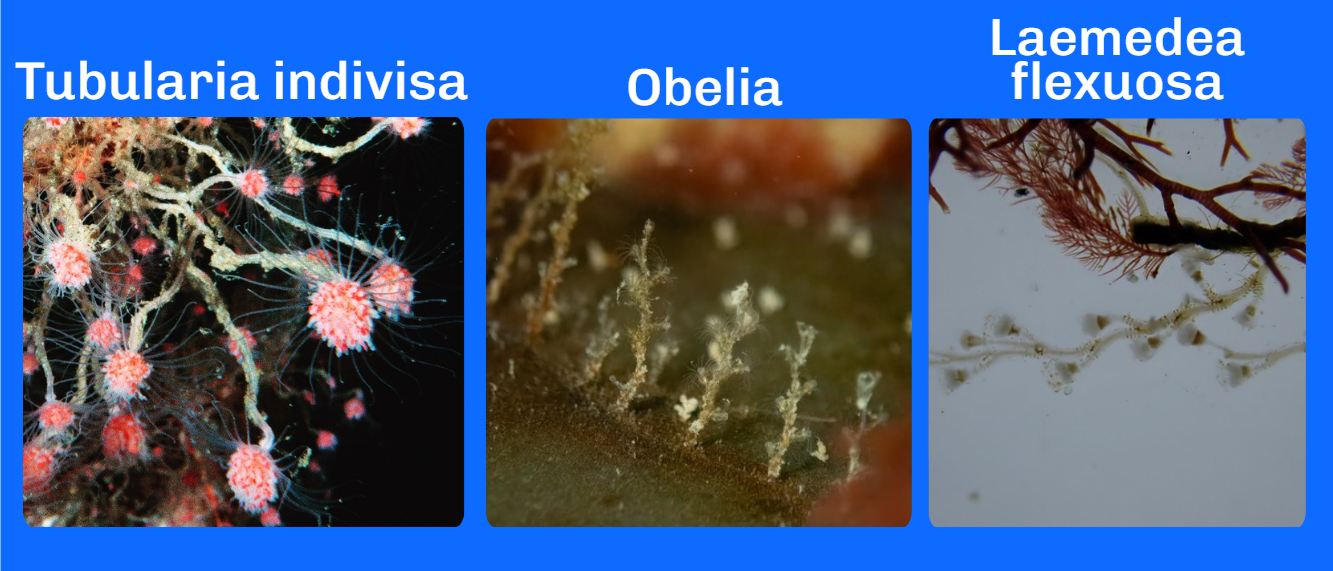
F. auriculata consumes various species of hydroid. These are sedimentary plant-like animals that contain many stinging cells as they are distantly related to jellyfish. F. auriculata are found consuming Obelia species of hydroid that grow on kelp, Tubularia indivisa and Laomedea flexuosa hydroids most frequently.
Facelina auriculata are voracious predators and have been known to consume smaller species of aeolid nudibranch, particularly Microchlamylla gracis which only reach 12 to 15mm long!

Facelina auriculata can be found under rocks and boulders on the mid to low shore, as well as rocky overhands and seaweed in deeper waters. They are a common species all around the UK but can be found as high as Norway and as low as Portugal. For the most up-to-date distribution records, see:
Facelina auriculata | NBN Atlas - Europe (mostly UK) database of species occurrence (best for historical records).
iNaturalist- most up to data records of the current species occurrence.
Picton, B. & Morrow, C. (2023). Nudibranchs of of Britain, Ireland and Northwest Europe (2nd ed). Princetown University Press.
Neal, K.J. (2007). Facelina auriculata, Slender facelina. In Tyler-Walters H. and Hiscock K. Marine Life Information Network: Biology and Sensitivity Key Information Reviews, [on-line]. Plymouth: Marine Biological Association of the United Kingdom.
Smith, Ian. (2022). Facelina auriculata (Müller, 1776) Identification and Biology. 10.13140/RG.2.2.10940.51844.
Alder, J. & Hancock, A. (1845-1855). A monograph of the British nudibranchiate mollusca. London, Ray Society. (As Eolis coronata.)
Galià-Camps, C., Araujo, A.K., Carmona, L., et al. (2033) Runcinidae and Facelinidae: Two complete mitogenomes of understudied and misleading heterobranch families (Gastropoda, Mollusca)


