
Our Crowdfunder campaign is now LIVE. We're raising £40,000 to help communities discover, monitor and care for the changing marine wildlife on their local coastline. Click here to find out more.
December 12, 2025
.jpg)
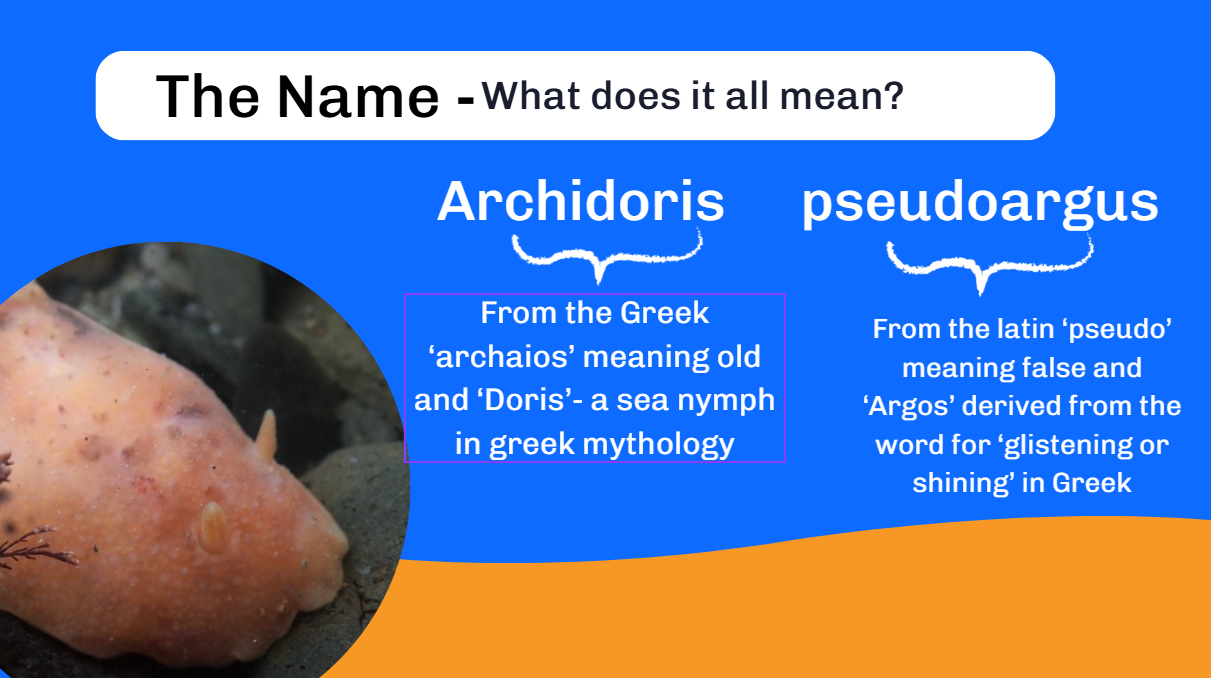
Archidoris pseudoargus, commonly known as the Sea Lemon, was first described by Rapp in 1827. They are a common sea slug found around the UK, with over 1,000 observations on iNaturalist, and over 6,000 observations made worldwide from GBIF. They are some of the most common nudibranchs found on British shores.
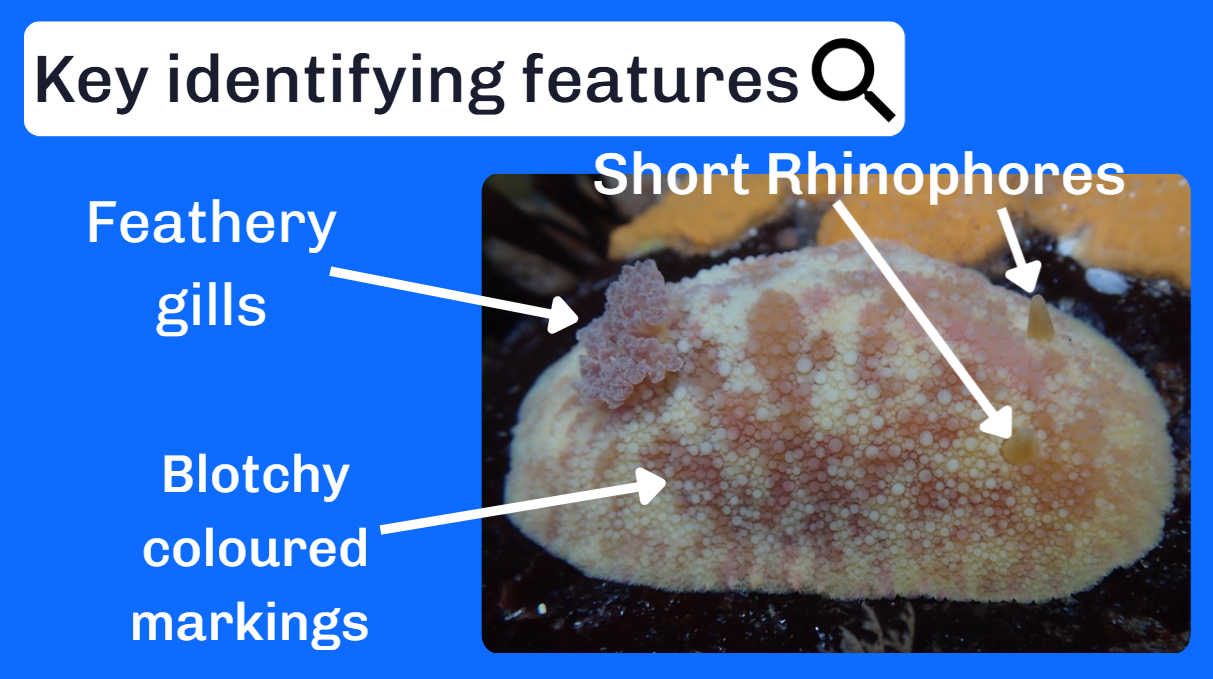
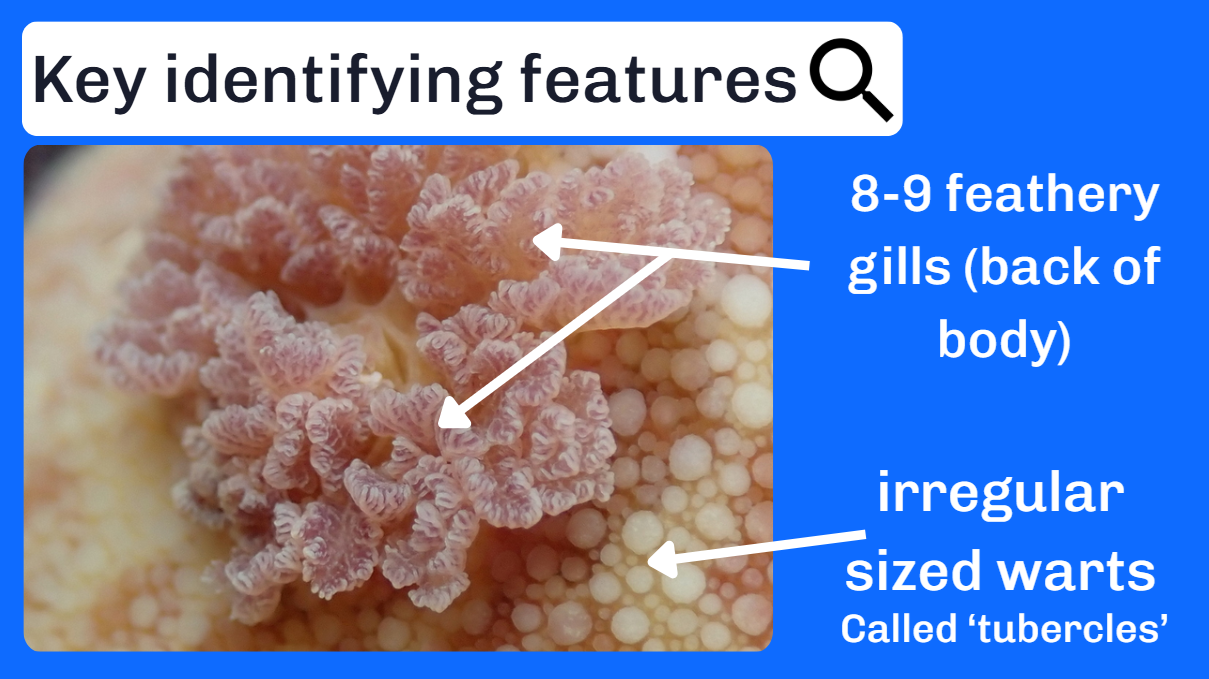
The sea lemon is a very large sea slug that can grow to sizes of 12cm. They are ovaloid but typically relatively shapeless and sit quite flat, almost moulded to the shape of whichever rock they're on when stationary. The mantle has two size classes of rounded tubercles on, which are both quite short. Their large mantle extends over their foot which is not normally visible unless the nudibranch is moving and they have 8 to 9 small, feathery, gill plumes on their back.
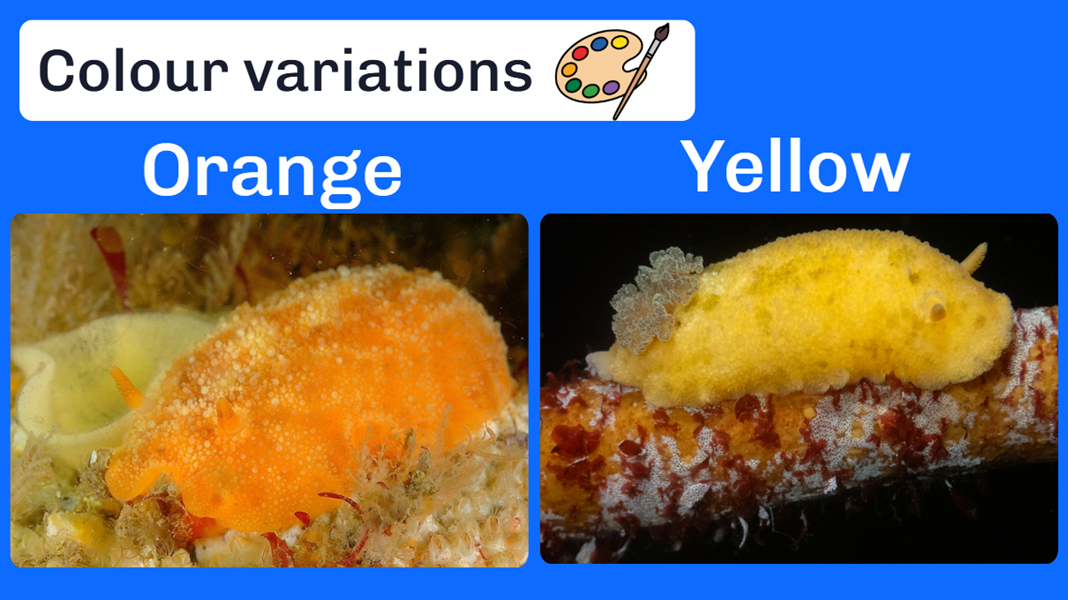
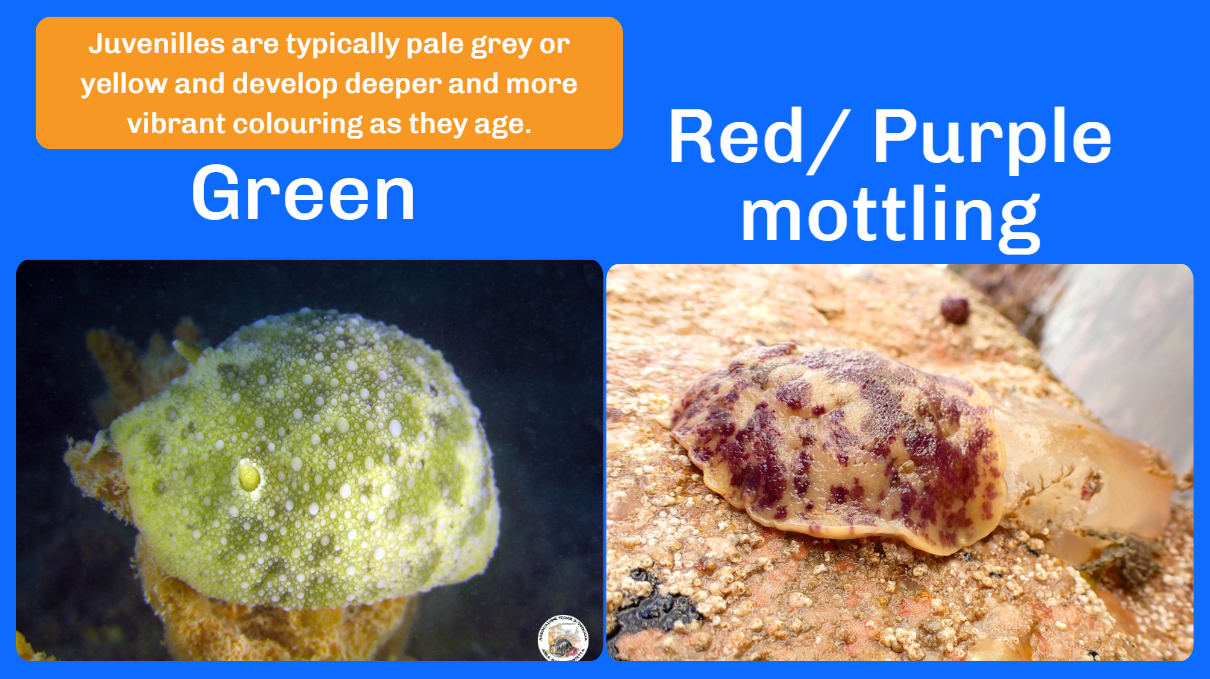
Sea Lemons generally have white, yellow or orange/ beige as a base colour, with darker blotchy markings on the body. The colours of the blotchy marking vary in colour, and each colour varies depending sponges they feed on and their life-stage but can be pink, green, purple or brown. There is also a variety of sea lemon with red markings (var. flammea). The mottled colouration likely aids camouflage.
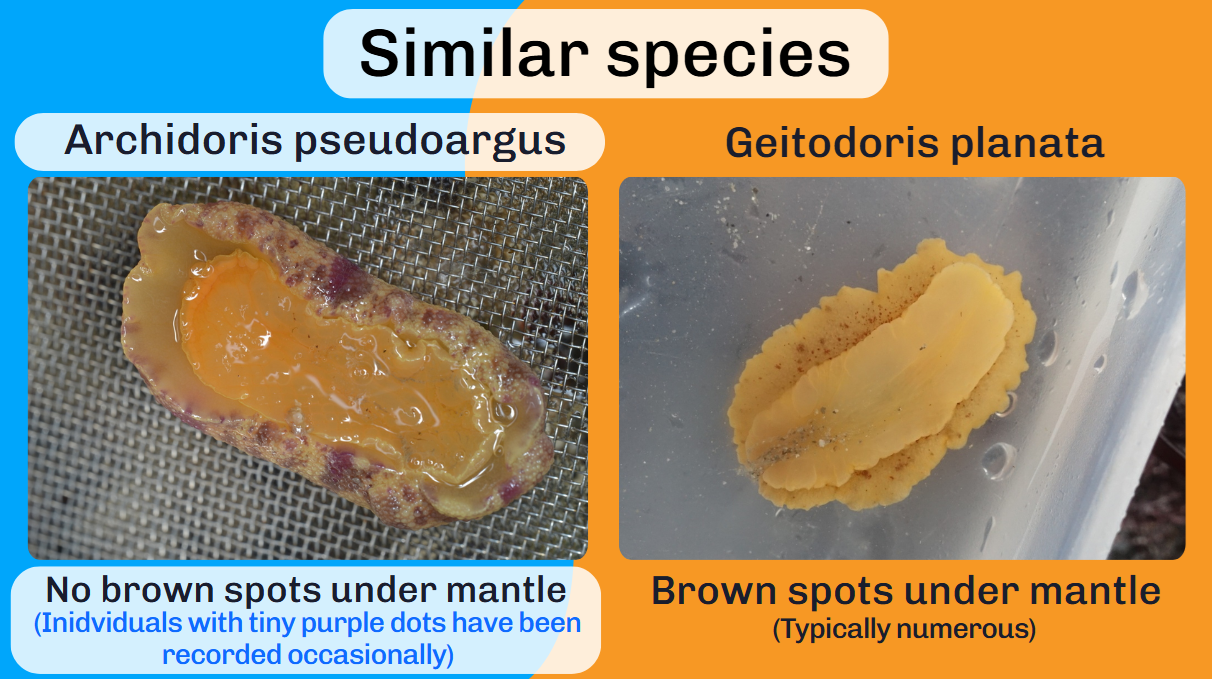
The sea lemon closely resembles Geitodoris planata, and the two species can easily be confused.
Size is a helpful identifying feature. Adult sea lemons can reach up to 12 cm in length, whereas Geitodoris planata can only grow to around half that size. This makes an easy unintrusive method for identifying larger specimens.
With smaller individuals and to confirm identification, you can carefully flip them over to examine under the mantle. The sea lemon’s mantle is typically smooth in colour and does not usually have spots, although individuals with small, sparse, purple spots have occasionally been recorded. In contrast, Geitodoris planata has numerous brown spots covering its mantle.
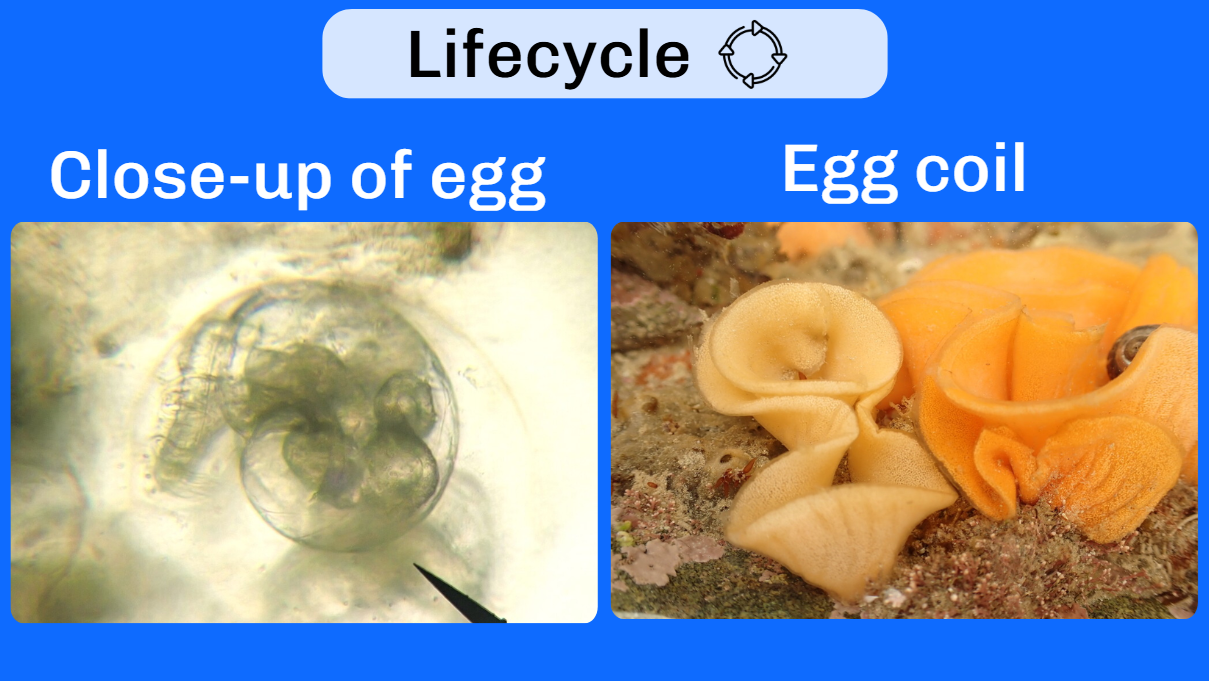
Individuals have male and female sex organs, and mate reciprocally (fertilise each others eggs simultaneously- simultaneous hermaphrodism), to produce a gelatinous mass of eggs. There may be hundreds to thousands of other tiny eggs in this ribbon-like mass. Mating and laying occurs mainly in Spring, with juveniles appearing in summer.
After hatching (which takes around 24-26 days), the larvae become free-swimming plankton. During this stage, they drift in the water column before eventually settling on the seafloor, usually near or directly on sponges — their main food source.
Unlike many sea slug species, which live for around one year, the sea lemon can live for up to two years.
These slugs are carnivorous consuming several species of sponge. Their main prey is the 'breadcrumb sponge' (Halichondria panicea) in the low intertidal zone, and Halichondria bowerbanki and Suberites ficus in the sublittoral zone.
The sea lemon is native to Europe and is particularly abundant around the coasts of the United Kingdom, mainly under boulders on the low shore and on rock faces down to 300m.
In recent years, the species has also been recorded in North America, with sightings reported in the United States in 2013 and Canada in 2023. In these regions, it is considered a non-native species.
This range expansion is thought to be linked to human activity. During its planktonic larval stage, the sea lemon can be transported in ships’ ballast water. It may also be introduced via sponges (its primary food source) that attach to boat hulls and are carried between regions.
For the most up-to-date distribution records, see:
National Biodiversity Network (NBN) - Europe (mostly UK) database of species occurrence (best to see historical records)
iNaturalist - most up to data records of the species occurrence
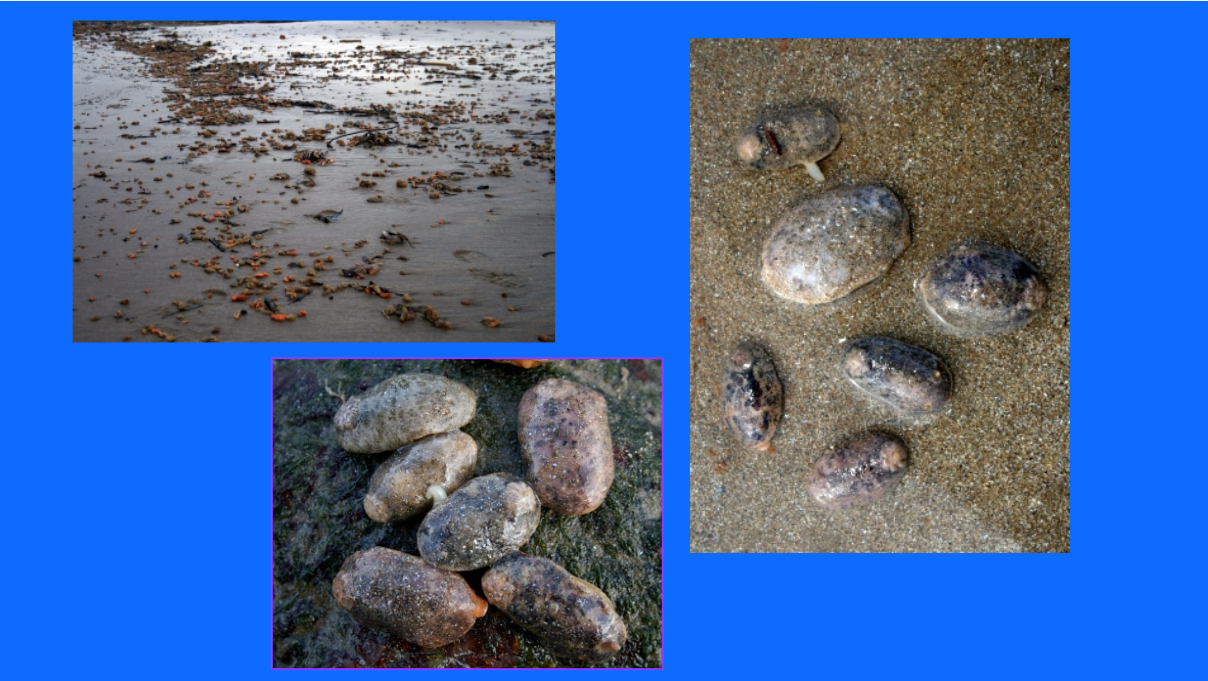
Sea lemons are voracious and successful predators, despite their rather benign look. They have been introduced to the East coast of the US which they are not native to, causing noticeable declines in sponge abundance in New England and Massachusetts. They can get so common in places like Wales at times, that mass strandings of them have occurred on Welsh beaches after storms, and walkers have seen hundreds of them washed up and strewn across the sand.
Ager, O.E.D. (2008). Archidoris pseudoargus Sealemon. In Tyler-Walters H. and Hiscock K. Marine Life InformationNetwork: Biology and Sensitivity Key Information Reviews, [on-line].Plymouth: Marine Biological Association of the United Kingdom. [cited20-02-2026]. Available from: https://www.marlin.ac.uk/species/detail/1856
Davies, J.(1993). Aspects of the life history and physiological ecology of long-livednudibranch molluscs, Thesis. University of St Andrews.
Picton, B.E. & Morrow, C.C. (2016). Archidoris pseudoargus (Rapp, 1827). [In] Encyclopedia of Marine Life ofBritain and Ireland.
https://www.habitas.org.uk/marinelife/species.asp?item=W14030 Accessed on2026-02-20
Raviraj,R., Scheetz, C., Carlton, J., Burns, K., Crosby, S., Cuzco, K., Donato, M.,Fajardo, M., Morrison, I., Olavarria, M., Romanello, D., Schwarzenbach, H.,Spiller, N., and Susarchick, J. (2025) Sea slug invasions: the non-nativeArchidoris pseudoargus (Nudibranchia: Dorididae) moves south and the nativeDoriopsilla pharpa (Nudibranchia: Dendrodorididae) moves north on the U.S.Atlantic coast. BioInvasions Records 14(3): 687–699.
Yang, Y.,Vannier, J., Lhéritier, M., and Ou, Q. (2026) Rethinking artiopod evolution:insights from the anatomy of Acanthomeridion from the early Cambrian ofChina. Royal Society Open Science 13(2): 250956.
Picton, B. & Morrow, C. (2023). Nudibranchs of of Britain, Ireland and Northwest Europe (2nd ed). Princetown University Press.


