
Our Crowdfunder campaign is now LIVE. We're raising £40,000 to help communities discover, monitor and care for the changing marine wildlife on their local coastline. Click here to find out more.
February 13, 2026
.jpg)
The Berthella plumula, commonly known as the Side-Gilled Sea Slug or Yellow-Plumed Sea Slug, was first described by Montagu in 1803. They are commonly found in Portugal, Spain, France, UK and Ireland. On iNaturalist there are currently over 400 research-grade observations and over 70,000 observations on the Global Biodiversity Information Facility (GBIF).
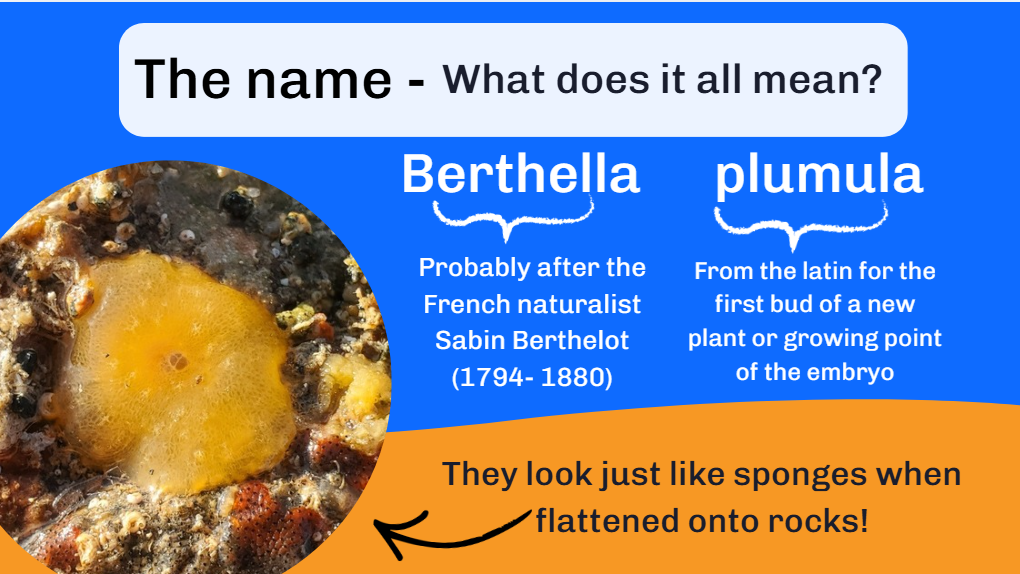
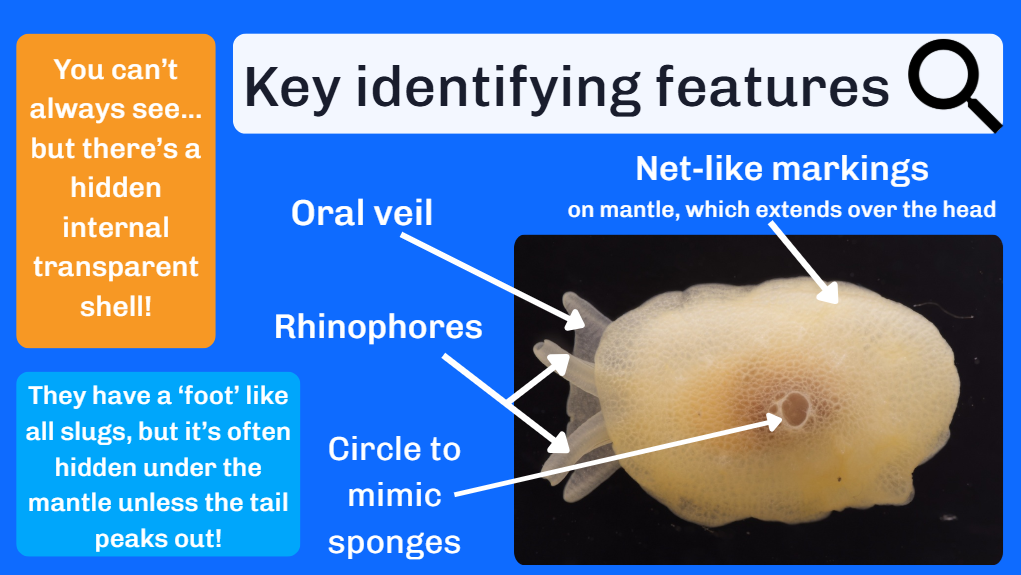
The Side-Gilled Sea Slug looks undeniably blob-like, especially when out of water, as their mantle extends far over their foot. Their rhinophores and oral veil become more prevalent in water, but they can still fully conceal their rhinophores when stationary, making them look like a perfectly circular sponge! Their net-like markings which surround a transparent circle in the middle of their body, are their most distinctive feature, and are also more visible when underwater. This helps camouflage them amongst their sponge prey, with the circle mimicking a sponges' oscule (large pore in its surface). Their oral veil helps them feed and sense the environment around them.
They can reach sizes of up to 60mm but are more commonly seen at sizes of around 30mm. Side-gilled sea slugs have an internal shell, and get their name from the gills on the right-hand side of their body concealed between their mantle and foot. You can view these from the side. They are very common under rocks on the rocky shore around the UK, and have been found at depths down to 30m.
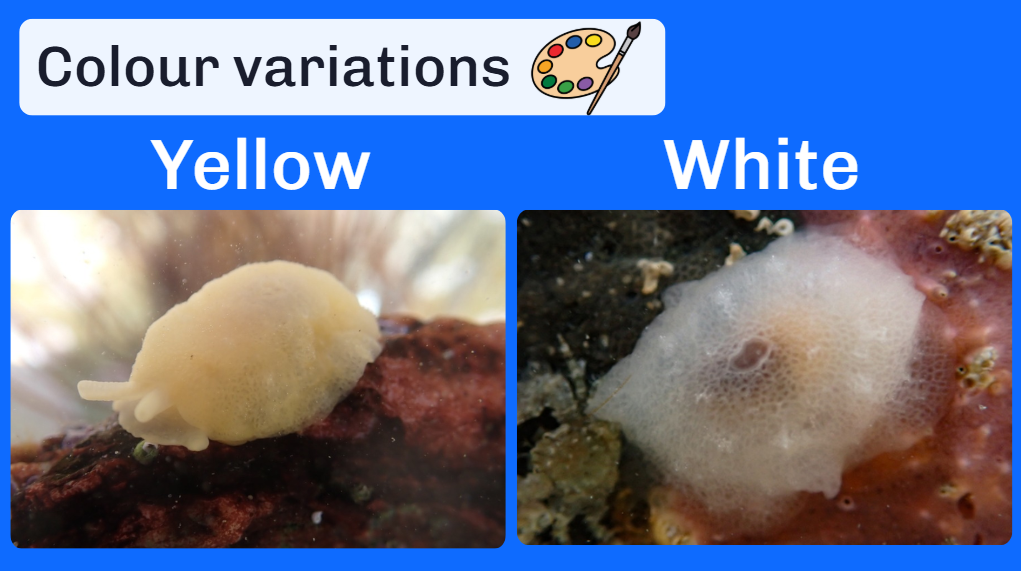
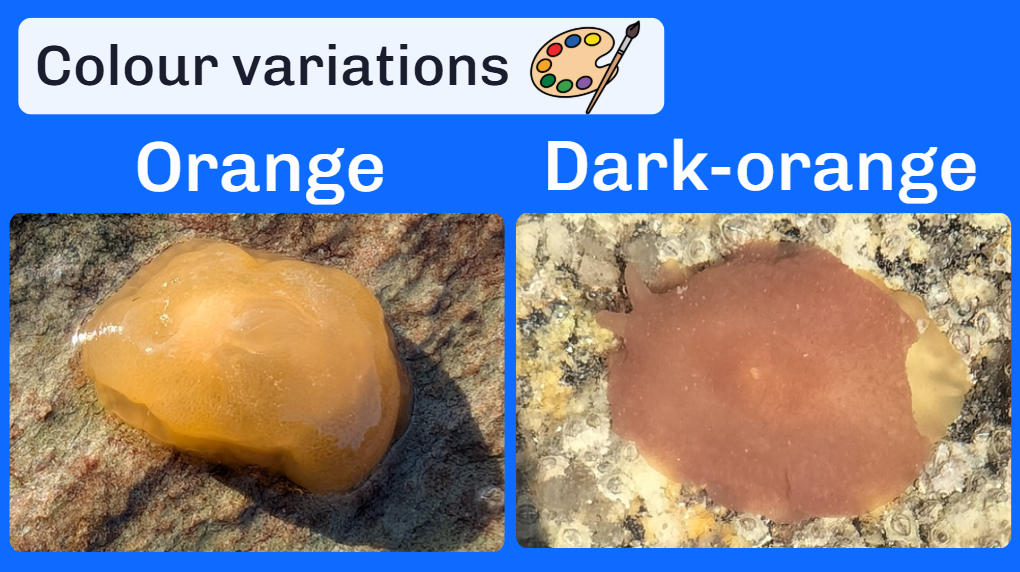
Colours range from white to cream, lemon-yellow, pale-yellow and orange. Varients of yellow are the most common colourations, with specimens consistently patterned with faint net-like markings. Some individuals are most translucent than others, making it easier to see their internal shell.
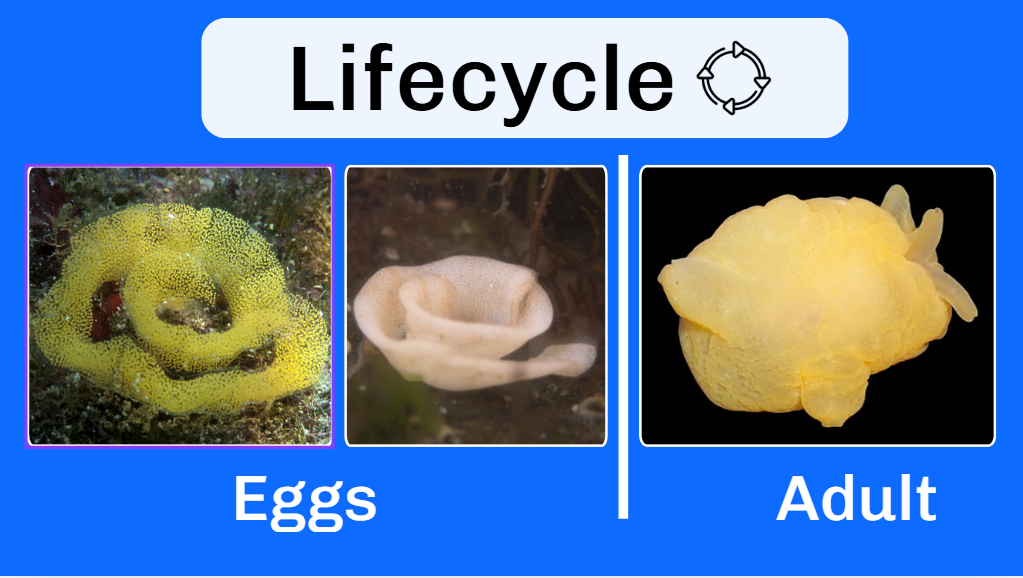
Reproduction mostly takes place in Spring. All individuals have both female and male reproductive organs and will line up next to each other to fertilise each other at the same time (simultaneous hermaphrodism). Egg masses made of hundreds of eggs are then laid in a spiral like membrane under rocks, ranging from white to a brighter yellow colouration. These eggs hatch into a planktonic larval stage, which will settle when their sponge prey is detected to metamorphose into their adult slug form.
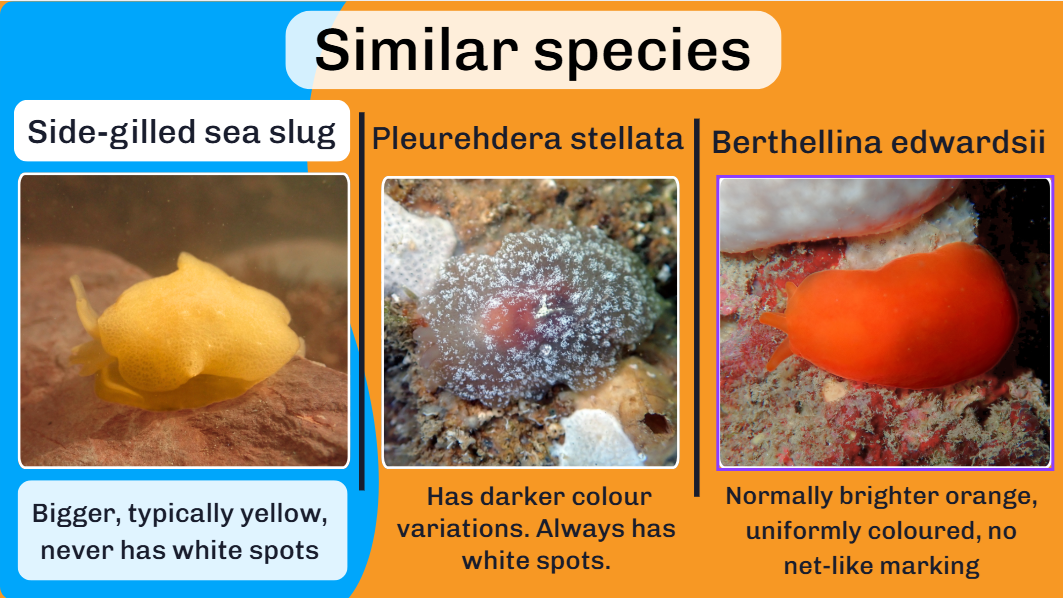
Side-gilled sea slugs are by far the most common of these species in the UK. All of these species are found across the Mediterranean, British and Irish coastline, but P. stellata and B. edwardsii are much more common in the Mediterranean than in Britain and Ireland, while the side-gilled sea slug is the opposite. The most reliable identification feature is its net-like markings which are not shared with any other of the similar species.
There are limited records of any predation occurring to adults of this species. Their excellent camouflage makes them challenging to find, and they have a number of physical defences ready if found, they are reasonably robust owing to their tough internal shell and the hard calcium carbonate 'spicules' (rods) interspersed throughout the softer mantle above the shell. They also produce sulphuric acid when threatened from glands in their skin to deter predators.
However, their eggs are known to be consumed by many species, including cushion stars and even other smaller species of slug!
These slugs feed on several species of sponges from the Oscarella genus. They will also eat colonial ascidians of the Botryllus genus. Foraging occurs mainly at night when these slugs are most active.
These slugs can be found from quite high on the rocky shore to depths of 30m in some cases (though deeper than 10 is unusual). For the most up-to-date distribtion records, see:
NationalBiodiversity Network (NBN) - Europe (mostly UK) database of species occurrence (best for historical records).
iNaturalist- most up to data records of the current species occurrence.
Hayward, P.J. & Ryland, J.S. (ed.) (1995). The marine fauna of the British Isles and north-west Europe. Volume 2. Molluscs to Chordates. Oxford Science Publications. Oxford: Clarendon Press.
Thompson, T. E. & Brown, G. H. (1976). British Opisthobranch Molluscs. London: Academic Press. [Synopses of the British Fauna, no.8.]
Thompson, T.E., (1976). Biology of Opisthobranch Molluscs, vol. 1. London: The Ray Society.
Picton, B. & Morrow, C. (2023). Nudibranchs of of Britain, Ireland and Northwest Europe (2nd ed). Princetown University Press.
Hayward, Peter J.; Ryland, John S., eds. (2017). Handbook of the Marine Fauna of North-West Europe.


