
Our Crowdfunder campaign is now LIVE. We're raising £40,000 to help communities discover, monitor and care for the changing marine wildlife on their local coastline. Click here to find out more.
April 29, 2026
.jpg)
Elysia Viridis, commonly known as the Solar-powered Sea Slug or Sap-sucking Sea Slug, was first described by Montagu in 1804. They are common in the UK and Ireland but can be found from Norway across France, Spain, Portugal, Italy and even the Azores. On iNaturalist there are currently nearly 1,500 research-grade observations and over 4000 observations on the Global Biodiversity Information Facility (GBIF).
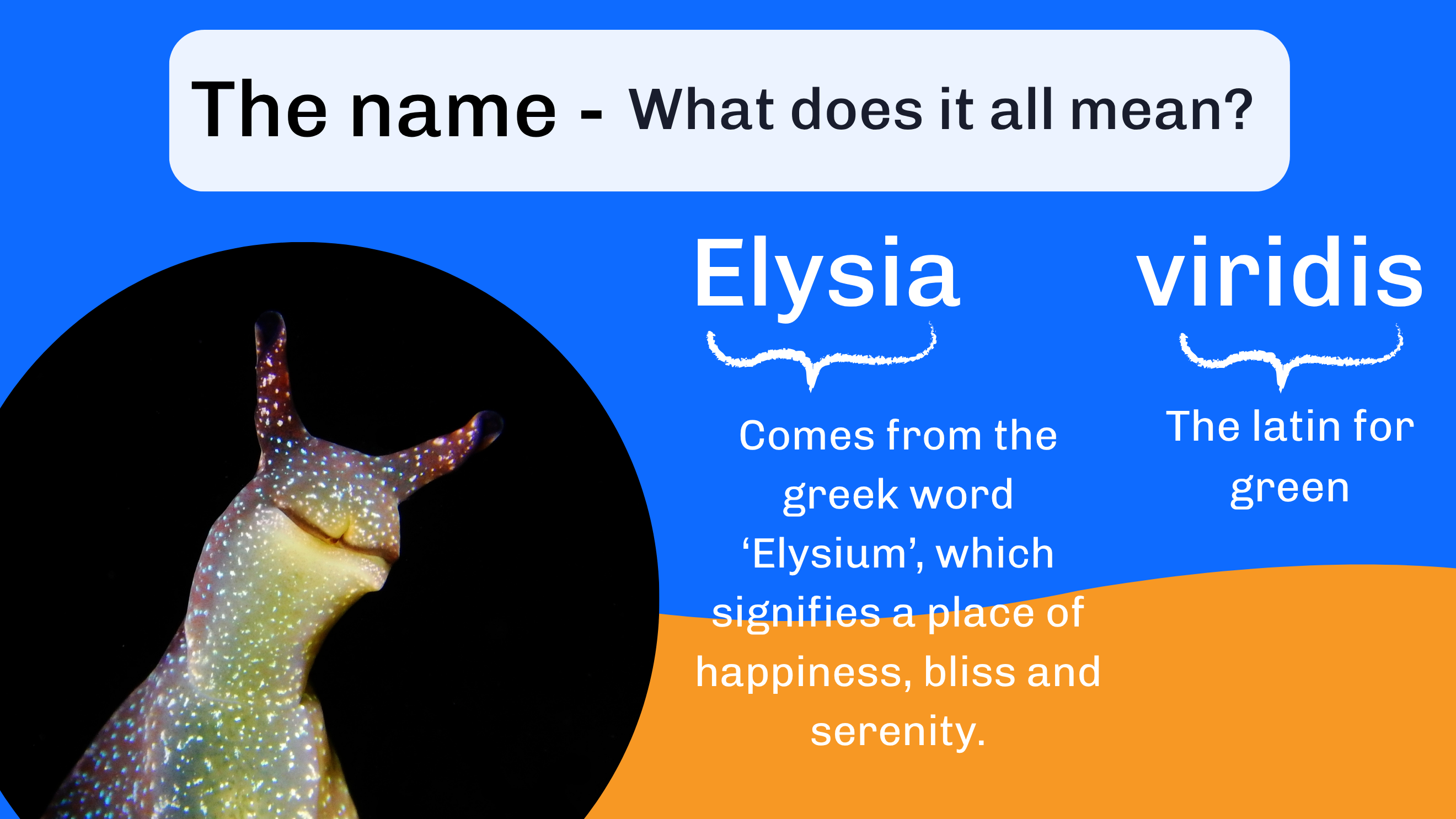
Elysia viridis are large ‘Sacoglossan’ sea slugs. Sacogloassans are a superorder of around 300 herbivorous slug species characterized by having specialised teeth in their ‘radula’ (mouthparts), that are adapted to pierce algal cell walls to suck out the contents. Hence the sacoglossans are often referred to as ‘sap-sucking sea slugs’. This group of sea slugs are in a different evolutionary branch to nudibranchs, which are all carnivorous.
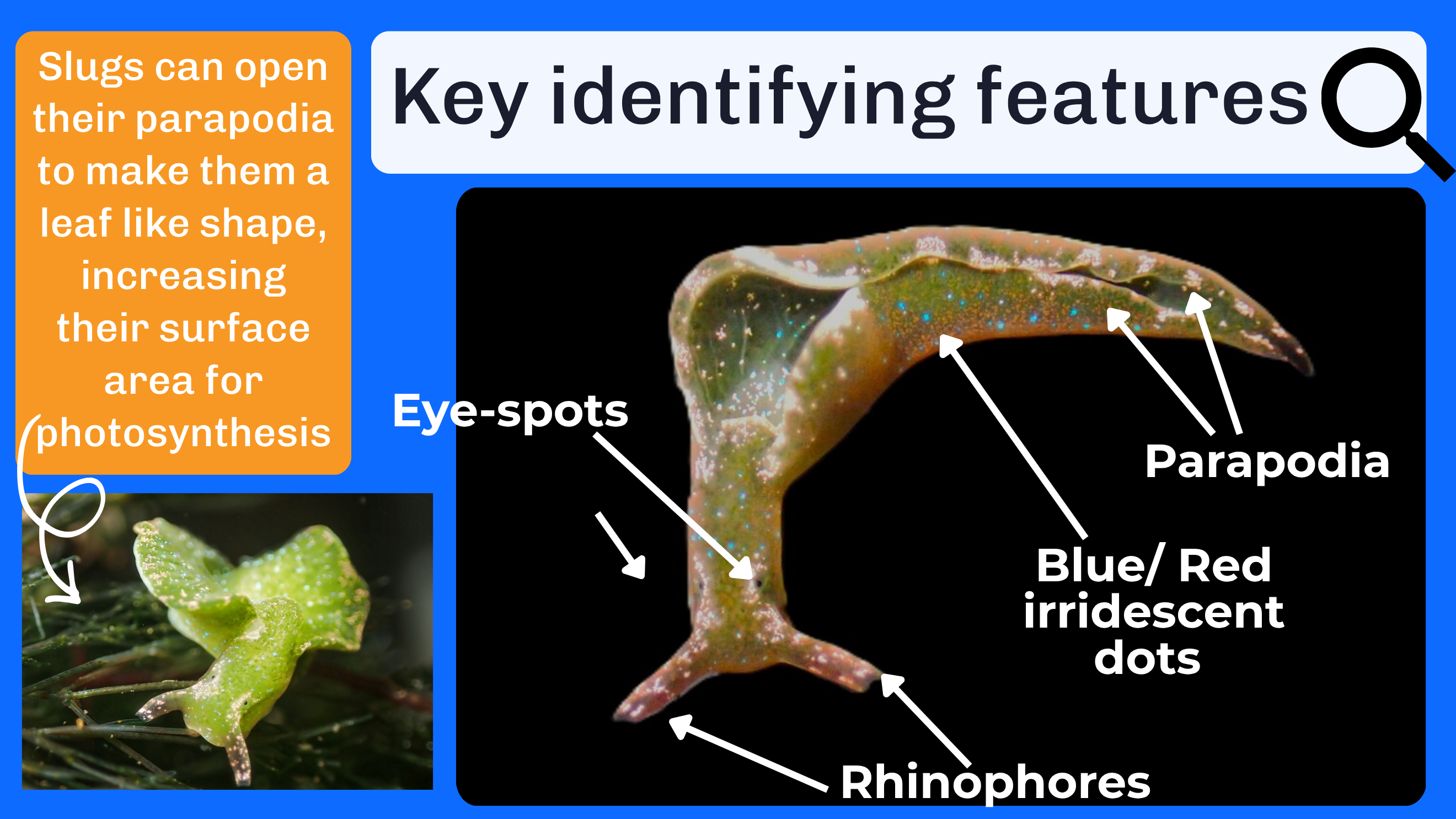
Solar-powered sea slugs normally reach 3-5cm in length in the UK, though a specimen of 70mm was found in the Netherlands! They have a large head with two tightly enrolled rhinophores that usually have white tips, but no oral tentacles.
They have two large wing-like extensions of the mantle called parapodia running from behind their head right to their tail. These have lobed or frilled edges which you can see when the slug unfurls them, to a shape that looks almost like a leaf from above, to increase their surface area.
In digestion, they can separate the chloroplasts sucked out of algae and retain them in their own cells close to the surface of their body, to provide energy for them from photosynthesis. This is called ‘kleptoplasty’, and you can see the ‘stolen’ chloroplast with a magnifying glass, they can be seen as tiny green speres, mainly in the parapodia of the slug. They are distributed by the slugs branching network of gut tubules which you can see as a feint leaf-vein like pattern just beneath their transparent skin on close inspection. Solar-powered sea slugs can keep the chloroplasts alive in its body for weeks to months!
The parapodia, head and body are normally covered in tiny glistening red, blue and green specks which have been known to move location on individuals. There is some information to suggest that the iridescent pigments are stored in round cells in the haemolymph (slug blood). They may help in camouflage through breaking up the slugs silhouette against the algae it consumes, though their true origin or purpose is not known.
Parts of the digestive gland and albumen gland (a gland that secretes substances to form and nourish egg capsules in many molluscs), are sometimes visible through the skin.
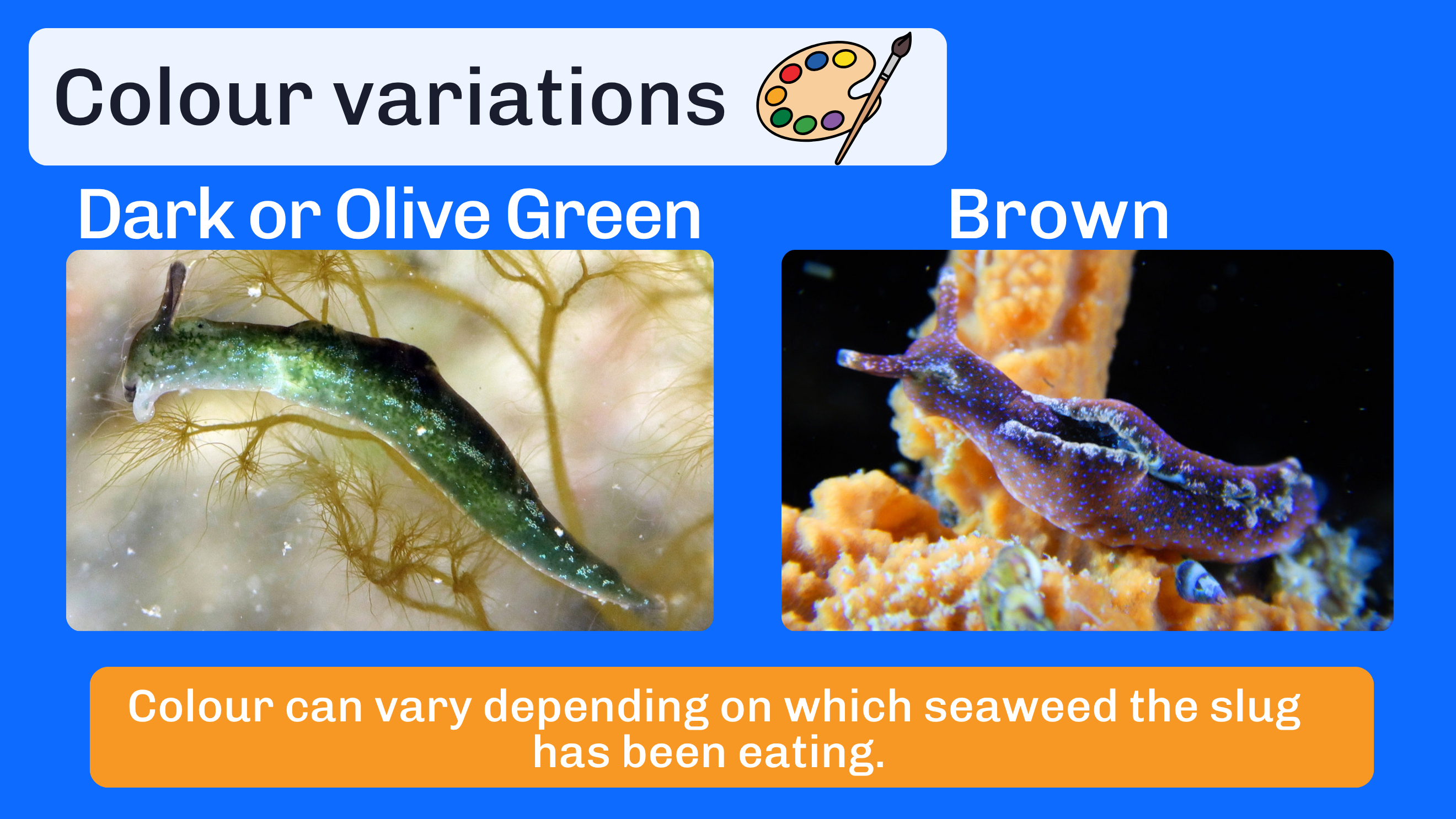
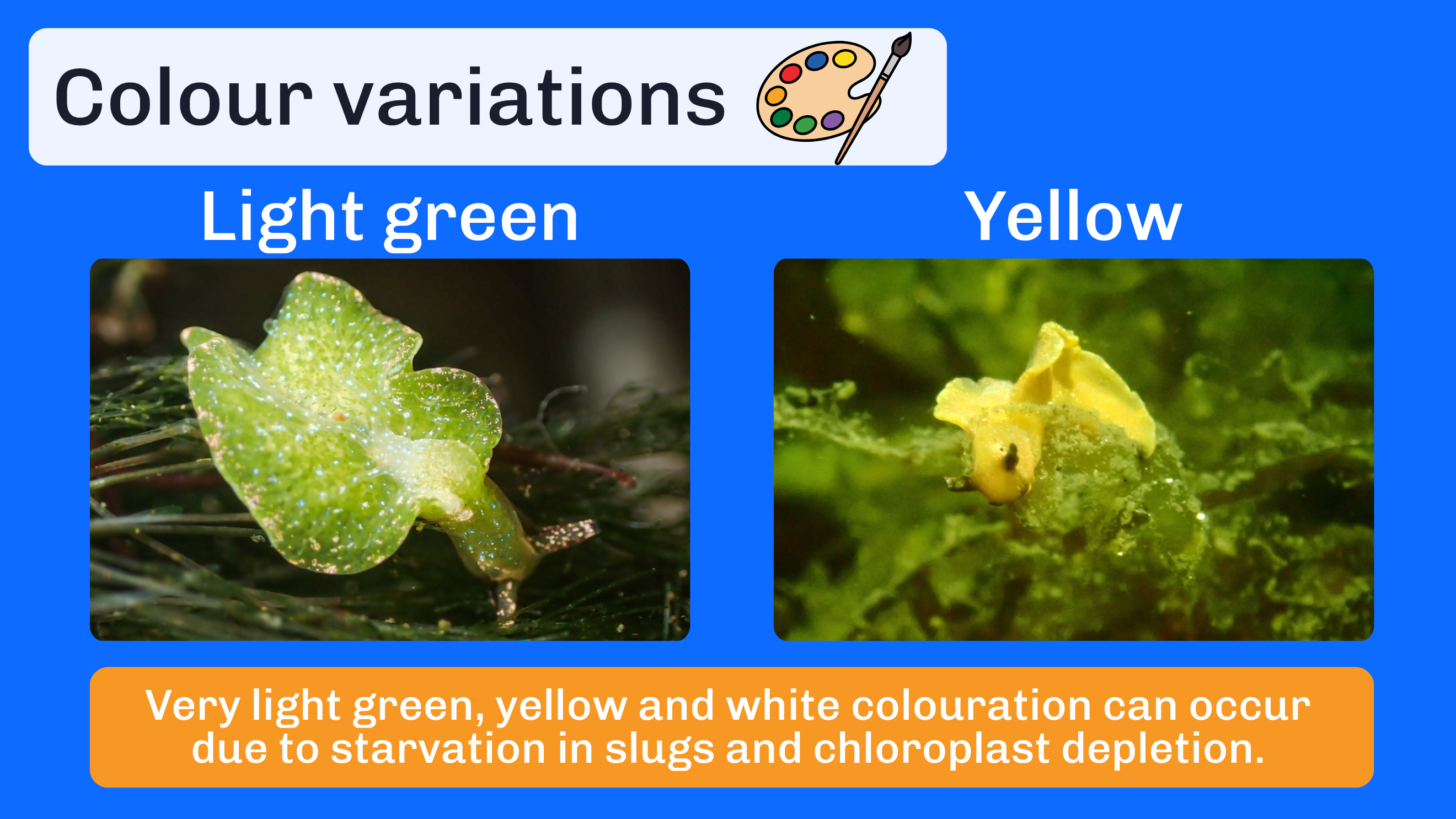
The body colour typically varies with diet from green to brown and almost red, dependent on which algae the slugs have been consuming. Pale green to yellow and almost white specimens are an indication the slug has been starved for enough time to deplete its chloroplasts and colouring.
Slugs may also have white patches on them, especially toward the edges of their parapodia, and black markings on the head or body.
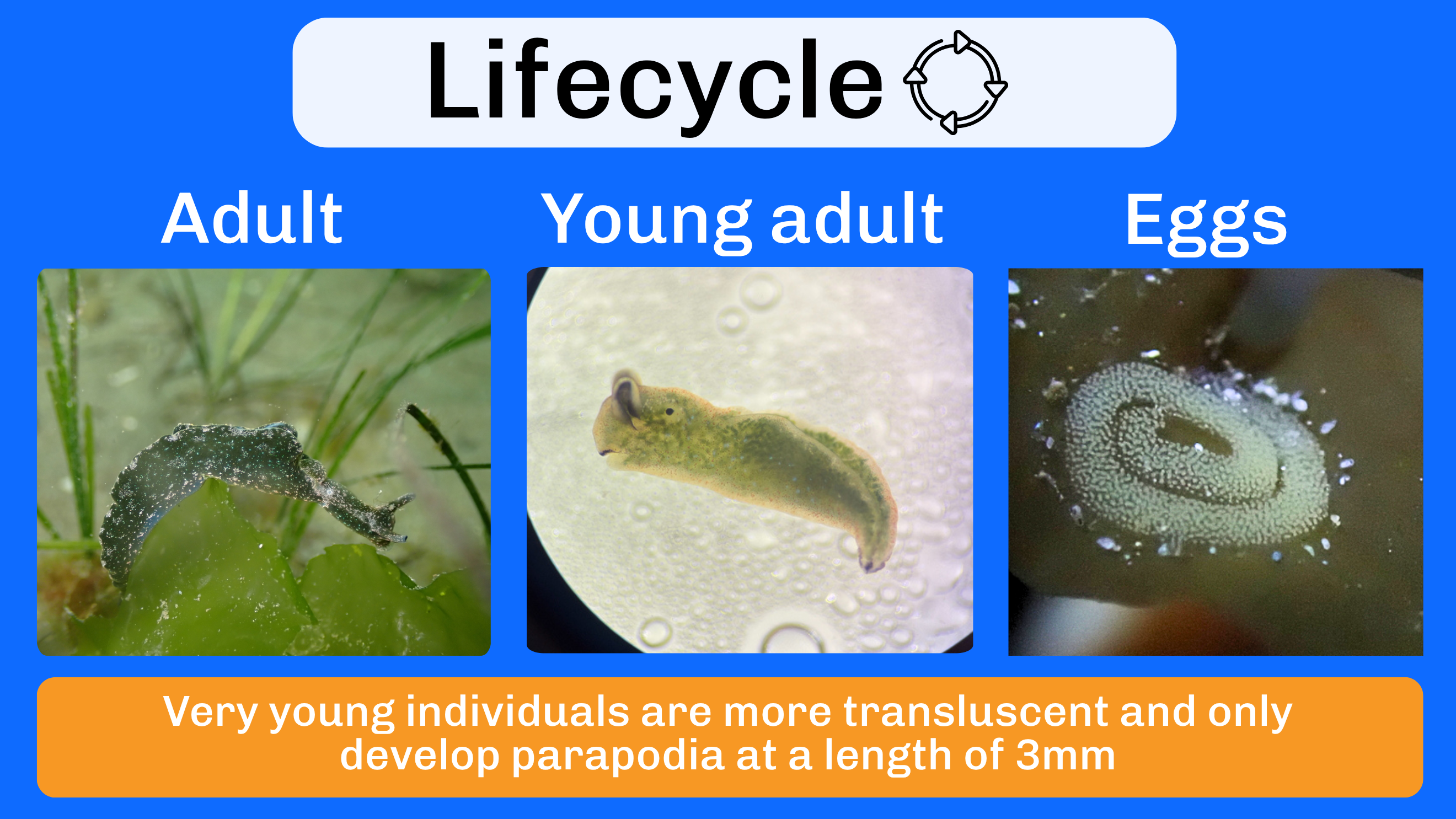
Solar-powered sea slugs each have both male and female reproductive organs. A pair lines up next to each other to fertilise both individuals' eggs at the same time (simultaneous hermaphrodism). They then lay a small egg mass in a coil of hundreds of eggs encased in a gelatinous membrane. These masses colouration depends on the seaweed the adult slug has been eating. As slugs in different countries tend to consume different species of seaweed this egg colouration effectively varies by country, with specimens in Denmark typically laying reddish-yellow eggs, and UK specimens' eggs ranging from lemon-yellow to bluish white. These hatch in 5 to 12 days (mainly dependent on temperature), to microscopic larvae. These tiny planktonic larvae drift for 30 to 45 days before settling on their preferred food algae and metamorphosing into slugs. These slugs have a 12 to 15 month lifespan.

Elysia viridis is the only Elysia species so far known in the UK, making adults quite distinct. Very young and tiny adults can be harder to identify as they only start to grow parapodia at a length of 3mm. However, younger individuals also tend to be quite translucent, with some bright green colouring as they have not yet built up many chloroplasts. They will also still have obvious, if a little stubby rhinophores. This distinguishes them quite easily from any potentially similar looking species like Limapontia capitata. However, in any reasonably size individual, the identification should be very easy!
This species is found on a variety of shallow-water algae across Europe but populations in each area tend to be specific to certain species of macroalgae, and individuals struggle to adapt quickly to feeding on other species when their environment is changed. In the UK, Elysia viridis feeds most commonly on Codiums or ‘sponge-finger seaweed’. The favoured codium species is thought to be an invasive seaweed species in the UK Codium fragile fragile, as it has thin walls, which are easier to pierce for feeding. In recent history, Scottish Elysia viridis were known to feed mainly on Cladophora algae, but as the alien C. fragile seaweed has spread north, feeding on Cladophora has become incredibly rare. In fact, when taken into captivity, adults from Scotland that were born feeding on the alien C. fragile had lost the ability to grow or feed on Cladophora seaweed, despite C. fragile only having been present in the area 3 years.
Solar-powered sea slugs’ growth rate and final body size is dependent on the type and volume of algae consumed, and the amount of energy received from retained chloroplasts.

Observed predation events of Elysia viridis are rare. Whether this is down to their excellent camouflage or just lack of observation effort we don't fully know. However, we do know that one of their closely related species, Elysia rufescens, can accumulate a compound called kahalalide produced by the Bryopsis alga it feeds on. This chemical is an effective chemical defence against fish predation for the seaweed and slug. It is unknown if our UK Elysia species Elysia viridis can do the same with any defensive chemicals from UK algae species.
Two species of Elysia viridis' warmer water cousins (Elysia marginata and Elysia atroviridis) are able to decapitate themselves and regrow a new body from their head! The discarded body will continue to move for a few days before dying, while the head regenerates a brand new heart and digestive system over the following weeks. Scientists believe this may be done to escape excessive parasite build-ups in their body and start again, or perhaps to escape predation as the body becomes a decoy. It is thought that they are able to do this thanks to the extra energy they have from the chloroplasts they store in their bodies. The rate of regeneration appears to be temperature dependent, with it happening quicker and more often successfully in warmer waters.
So, while this extreme amputation hasn't been observed in our UK species Elysia viridis, is this because the species just can't do it, or perhaps because our waters are too cold for the process? The species shares the deep groove separating its head from the rest of its body that E. marginata and E. atroviridis have, and split along when they decapitate themselves!
Elysia viridis are common across Europe and enhabitat a variety of shallow water habitats, including those of lower salinity that most sea slug species cannot tolerate. They seem to also be increasing in population across the UK as waters warm. For the most up-to-date distribution records, see:
Facelina auriculata | NBN Atlas - Europe (mostly UK) database of species occurrence (best for historical records).
Sap-sucking Slug (Elysia viridis) · iNaturalist- most up to data records of the current species occurrence.
Trowbridge, C.D., (2000). The missing links: larval and post-larval development of the Sacoglossan opisthobranch Elysia viridis. Journal of the Marine Biological Association of the United Kingdom, 80(6), 1087-1094.
Becerro, M.A., Goetz, G., Paul, V.J. and Scheuer, P.J. (2001). Chemical defenses of the sacoglossan mollusk Elysia rufescens and its host alga Bryopsis sp. J Chemical Ecology, Volume 27, Issue 11, pp 2287–2299.
Jensen, K.R. (1989). Learning as a factor in diet selection by Elysia viridis (Montagu) (Opisthobranchia). Journal of Molluscan Studies, 55, 79-88.
Baumgartner, Finn A. and Toth, Gunilla B. (2014). "Abundance and Size Distribution of the Sacoglossan Elysia viridis on Co-Occurring Algal Hosts on the Swedish West Coast". PLOS ONE. 9 (3)
Trench, R. K., Boyle, J. Elizabeth., Smith, D. C., Harley, J. L. (January 1997). "The association between chloroplasts of Codium fragile and the mollusc Elysia viridis - III. Movement of photosynthetically fixed 14C in tissues of intact living E. viridis and in Tridachia crispata". Proceedings of the Royal Society of London. Series B. Biological Sciences. 185 (1081): 453–464.
Smith, I. F. and Storey, M. (2012- revised 2021). Elysia viridis (Montagu, 1804) Identification and Biology.
Picton, B. & Morrow, C. (2023). Nudibranchs of of Britain, Ireland and Northwest Europe (2nd ed). Princetown University Press.


